Scarf Knots That Stay Put, and the Ones That Come Undone by the Second Block
Four knots, the necklines each one suits, why fabric friction decides whether a knot survives a walk, and how scarf length relates to height.
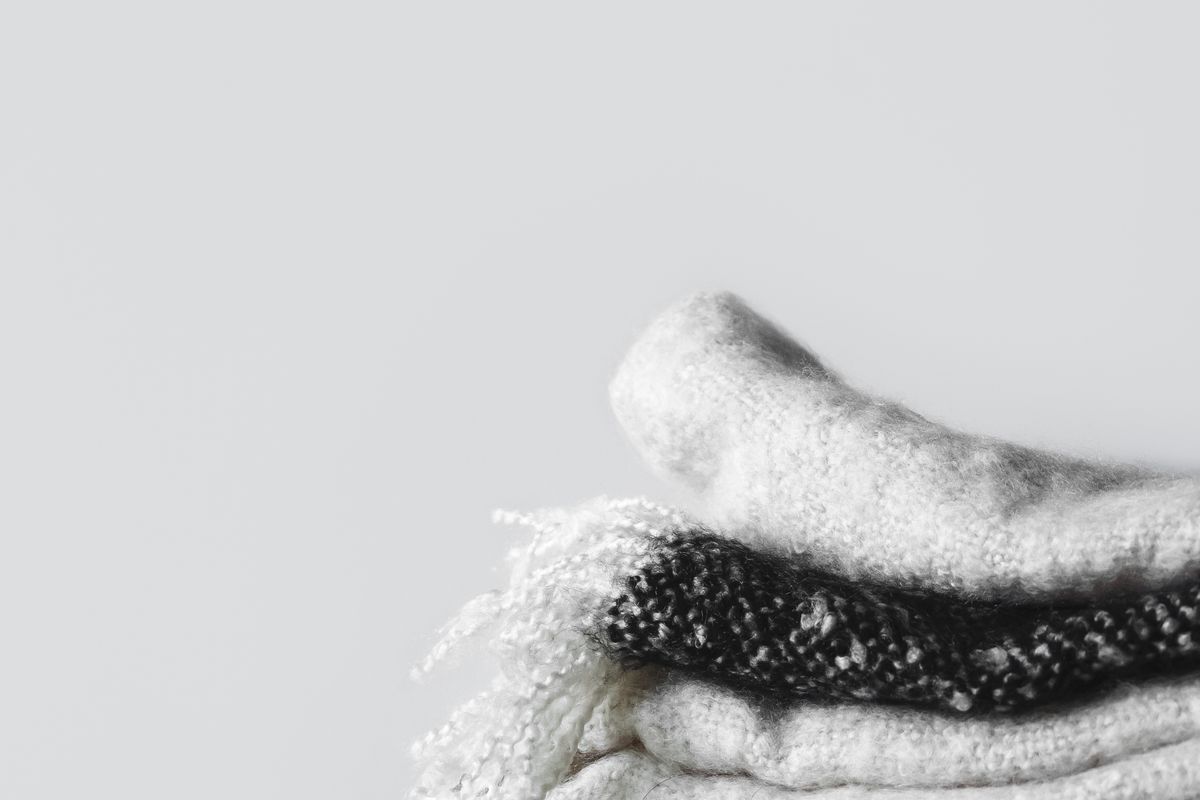
A knot that looks right in the mirror and is gone by the second block of walking is a fabric problem, not a technique problem. Fibre decides which knots are available; the knot decides which neckline it suits.
Four knots, and the necklines they suit
The once-around loop is a single wrap with both ends falling in front. It works in every fibre, holds a crew neck and an open collar equally, and is the easiest to adjust when the ends land unevenly. It is also the least warm, since it leaves gaps at the throat.
The Parisian knot — folded in half, both ends pulled through the loop — sits compact and high, which is what a V-neck, a blazer or a raised coat collar wants. It is a slip knot: self-adjusting, which also means it loosens steadily through the day.
The four-in-hand, tied like a necktie, produces a neat triangular shape and sits flat against the chest. It needs a narrow scarf in silk or fine cashmere and reads as the most formal of the four; under a buttoned shirt collar it is the only one that holds its shape.
The ascot knot, tied loosely with the ends left to fall, suits an open collar and a sport coat. It is a style knot rather than a warmth knot, and it works best in soft, medium-weight fabric that has enough body to keep the front from collapsing.
Fibre decides what holds
Silk and rayon slide. Their low friction produces the drape that makes them worth wearing, but it means a loose wrap will not survive movement. Silk wants compact knots close to the neck, a scarf ring, or a square knot — the one basic knot that grips rather than slips.
Wool and cashmere grip themselves. They hold loose and open shapes with no effort, which is why the once-around and the ascot are casualwear defaults in those fibres. The trade-off is bulk: forcing a heavy wool scarf into a small tight knot piles volume at the throat, where the face is.
Cotton and linen hold their shape and stand slightly away from the body. They take a knot cleanly but never mould the way wool does, which makes them better at structured neckerchief styles than at the soft wrap.
Length and height
The rule used across knitting and textile references is that a scarf should be about as long as the wearer is tall. Standard scarves run 60 to 80 inches; ascot lengths run 40 to 50 and extended lengths above 80. At the height-matched length, the ends of a draped scarf fall around the hip.
Shorter than that and the Parisian knot has no tail to pull through. Longer and the extra fabric only buys more wraps. Measuring a scarf already in the drawer against the body settles the length question faster than any chart.
What comes undone while walking
In order of likelihood: the plain drape (no knot at all) shifts within a minute; a single overhand knot works loose steadily; the Parisian slip knot loosens and needs re-tightening; the four-in-hand holds best. Fibre reorders that list — the same overhand knot that fails in silk will hold all day in a napped wool, for the friction reason above. Choosing fibre by behaviour rather than by look is the same move that separates merino from cotton as a base layer.
The one step: pick the knot by fibre first — compact for silk, loose for wool — and re-tie it in the mirror once before leaving rather than twice outside.
FAQ
- Which scarf knot is most secure?
- A square (reef) knot — left over right, then right over left — lies flat and holds through a full day of walking. If the finished loops twist over each other it is a granny knot, which works loose. A single overhand knot is the least secure of the three.
- Does scarf length depend on height?
- Yes. The rule used across knitting and textile references is that a scarf should be about as long as the wearer is tall. Most standard scarves fall between 60 and 80 inches; ascot lengths run 40 to 50 inches and extended lengths above 80 inches.
- Why does a silk scarf slide loose while wool holds?
- Silk and rayon have a low coefficient of friction, so the fabric slides against itself and needs a compact knot or a scarf ring to stay closed. Wool and textured cotton grip themselves, which is why loose wraps hold in those fibres and fall apart in silk.
Written by
Maya Ellis
I started Dressing Time after one too many orders that came back in the wrong size. Everything here is built from published specifications, brand measurement charts and what owners actually report.
More in Accessories