The Measurements Worth Taking Before You Order
Eight numbers settle most fit questions — four for anything with sleeves, four for trousers. Where each one starts and ends, and how to keep the set usable.
Eight numbers settle most fit questions. Four for anything with sleeves, four for trousers. Taking them once, carefully, turns every future size chart into a lookup instead of a decision.
The four upper-body numbers
| Number | Where the tape starts and ends |
|---|---|
| Shoulder width | Across the back, from the bony point at one shoulder to the other — not the edge of the muscle |
| Chest | Around the fullest part, tape parallel to the floor, on a normal exhale |
| Sleeve length | From the shoulder point down the outside of a slightly bent arm to the wrist bone |
| Body length | From the bump at the base of the neck, over the shoulder, down the front to where the hem should sit |
Sleeve length is the one that never lines up, because the starting point is not standardised. Some brands measure from the shoulder seam; others start at the centre of the back of the neck and run across the shoulder, which reads longer for the same arm. A two-inch gap between a chart and a tape measure is often that difference and not a real one.
The four trouser numbers
| Number | Where the tape starts and ends |
|---|---|
| Waist | At the natural waist — the crease that forms when bending sideways — not at the top of a waistband |
| Hip | Around the fullest part, feet together, weight even |
| Thigh | Around the fullest part of one thigh, standing normally |
| Inseam | From the crotch down the inside leg to the ankle bone, wearing the shoes the trousers will go with |
Waist is where most people measure the wrong thing. The natural waist sits above the navel and well above where most modern trousers are worn, and the two are not the same number.
Taking them so they repeat
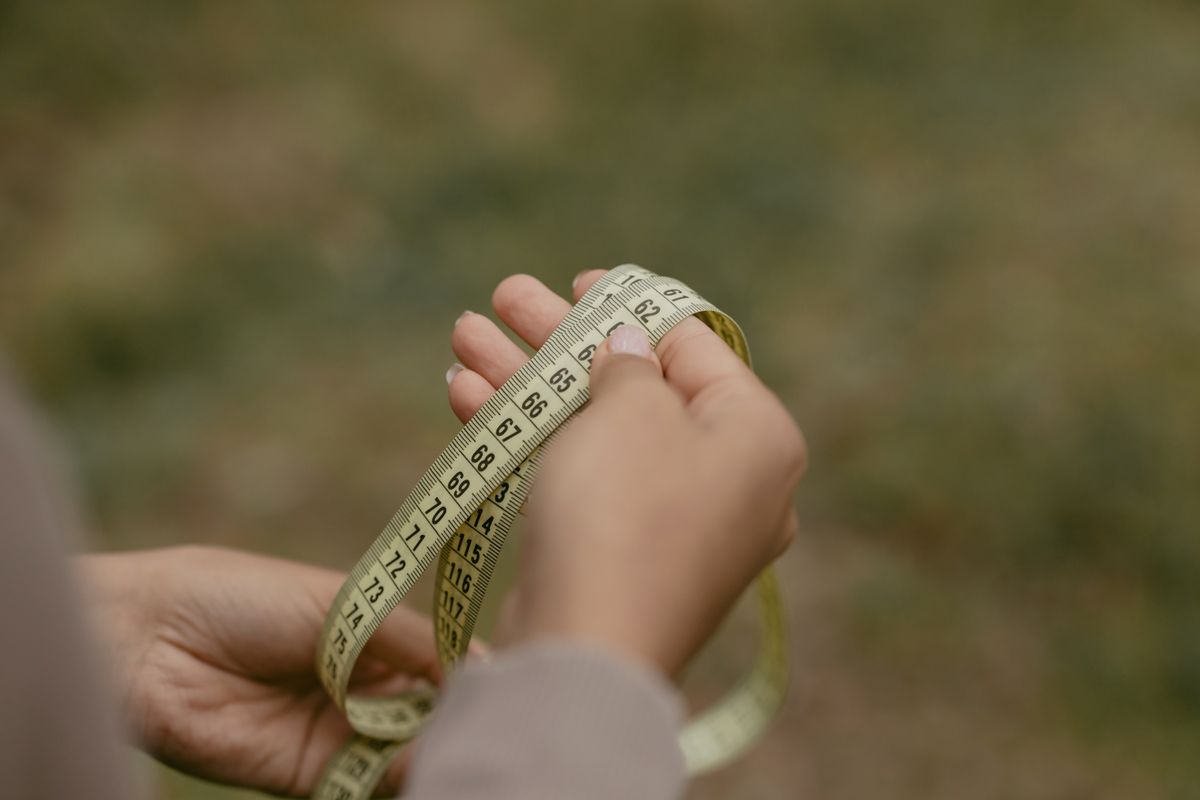
Use a soft tape with one finger underneath it, so there is tension but no compression. Measure over whatever will be worn underneath — a tape against bare skin gives a number that does not survive contact with a shirt. Take each measurement twice and keep the larger of the two. Measure at a consistent time, because bodies are not identical at every hour.
Turning the numbers into a reference set
Body numbers alone are half the tool. The other half is the flat measurements of one garment per category that already fits — shirt, trousers, jacket. Which of the two a given chart is describing decides which set to compare, and how to read a size chart covers how to tell them apart.
The gap between the two sets is the ease that has been working all along. Naming it turns a preference into a number, which is what ease in a garment is about.
Put all eight numbers, plus the flat measurements of the reference garments, in one note. Every chart after that takes seconds.
FAQ
- Should body measurements or garment measurements come first?
- Keep both. Most size charts describe the garment rather than the body, so garment numbers are what you compare against a chart — but body numbers tell you how much ease you have been wearing without knowing it, which is what lets you judge a chart that only lists body targets.
- Why does my sleeve length never match a chart?
- Because the starting point differs. Some brands measure from the shoulder seam down the arm, others from the centre back of the neck across the shoulder. The second method reads longer for the same arm, and the chart rarely says which one it uses.
- How often should measurements be retaken?
- Once a year is enough for most people, and again after any change in weight. Measuring at a consistent time matters more than the interval, because bodies shift slightly over the course of a day.
Written by
Maya Ellis
I started Dressing Time after one too many orders that came back in the wrong size. Everything here is built from published specifications, brand measurement charts and what owners actually report.
More in Fit & Buying Guides