Waxed Cotton Stiffens in the Cold, and That Is the Point
A waxed jacket is not a rain shell. How the wax finish behaves at 35°F, what it does to fit through the shoulders, and when re-waxing is worth the tin.

A waxed jacket left in an unheated hallway at 35°F will stand up on its own. Not entirely, but close enough that first-time owners write to customer service convinced the thing has shrunk or gone stiff with age.
It has done neither. The paraffin in the finish has hardened, and it will soften the moment the jacket is worn. That behaviour is the finish working, not failing.
What the wax is doing
Waxed cotton starts as a tightly woven cotton, usually between 6 and 12 ounces per square yard. The finish is a blend of paraffin and beeswax worked into the cloth, which makes the fibres shed water and gives the fabric its weight and smell.
Paraffin is temperature-sensitive. Warm, it stays soft enough to move when the cloth bends. Cold, it locks, which is why the same jacket drapes at 60°F and stands at 35°F. And because the wax sits in and on the yarn rather than in a separate film, there is no membrane to delaminate; the finish fails by wearing thin, never by peeling off in sheets the way a coating can.
Three consequences follow. The jacket is water-resistant rather than waterproof, it does not breathe the way a membrane shell does, and it holds shape. Because the wax sits in the cloth, it also picks up marks. Creases go pale where the wax cracks. Sleeves darken at the elbow. A jacket worn hard looks worn hard, and there is no way to clean it back to new. Some people buy waxed cotton for exactly that.
How the finish changes fit
Wax adds stiffness and a little weight, but almost no measurable thickness. The jacket does not fit smaller after re-waxing. What changes is how it moves.
A new waxed jacket feels like it has a memory. The shoulders crease where you bend them and stay creased, and the sleeves resist a full overhead reach until they have been broken in over a few weeks of wear. If the jacket is cut close through the chest to begin with, that resistance never really goes away, and the front pulls when you drive or reach for a shelf.
This is why traditional waxed jackets are cut roomy, with a shoulder that sits slightly past the natural one and enough room for a sweater. Sizing down to get a cleaner silhouette usually produces a jacket you cannot layer under and cannot raise your arms in. Check the chest with the thickest midlayer you own, then leave the extra room alone.
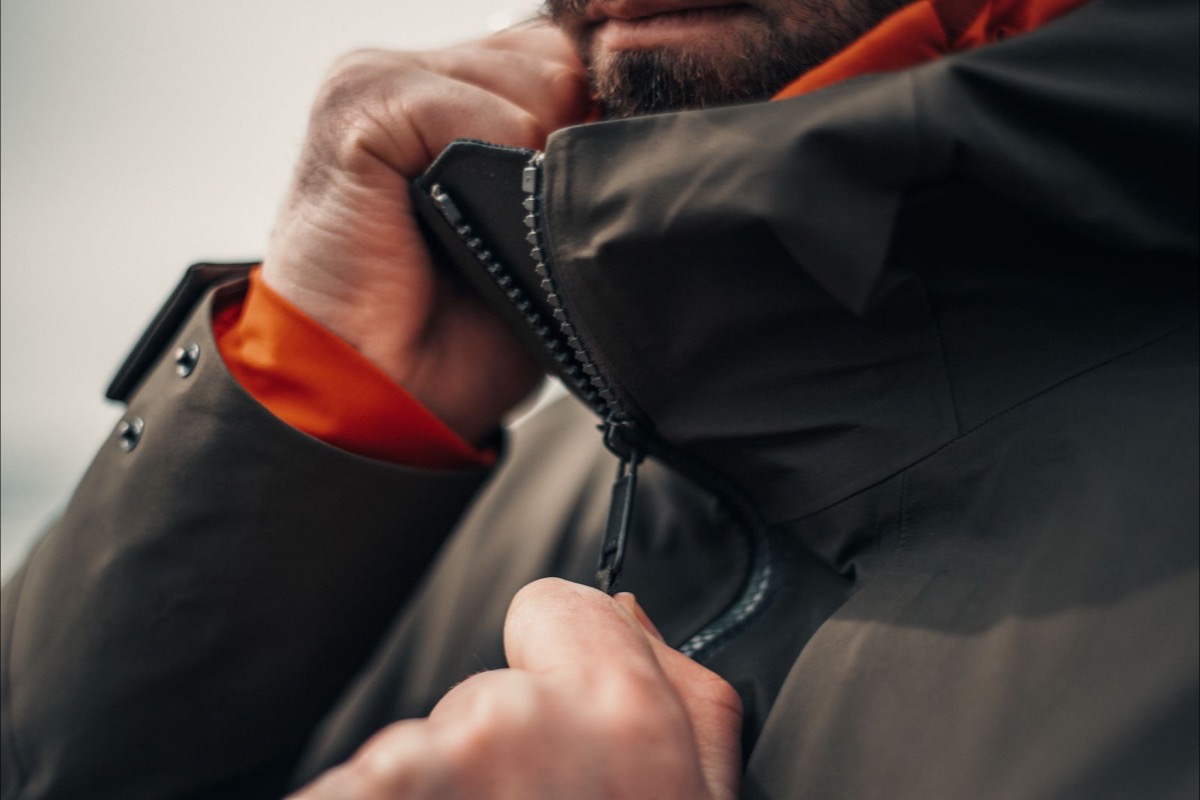
The collar is the other fit decision. A corduroy collar is there to be turned up and to stop the waxed cloth chafing your neck. If the collar stands away from your neck by more than a finger’s width when turned up, wind will find the gap and the jacket will feel ten degrees colder than it is.
Breaking in a new jacket
The stiffness wears out faster with help. Wearing the jacket is the main method: body heat softens the wax, and each bend of the elbow sets the crease where the cloth actually folds instead of where it was folded on the hanger. Working the sleeves by hand, bending the elbow a few dozen times and rolling the cuffs, speeds up the same process on a jacket that arrives before the weather does.
Hanging matters more than owners expect. A wide wooden hanger supports the shoulder the way a body does; a thin wire hanger lets the wax set a crease across the shoulder line that shows up later as a pale ridge. After rain, hang the jacket at room temperature and let it dry before it goes back in the closet.
The list of what not to do is short. No dryer, no radiator, no flattening the creases with an iron, because an iron melts wax into the cloth and the lining in a single pass.
Re-waxing, in order
Re-proof when the cloth starts darkening in rain instead of beading. Shoulders, elbows and cuffs go first.
Warm the tin in a bowl of hot water until the wax is liquid. Wipe the jacket down with a damp cloth and let it dry completely. Apply the wax in thin coats with a lint-free cloth, working it into the seams and the areas that have gone pale. Hang the jacket somewhere warm overnight so the wax settles, then wipe off the excess with a clean cloth.
Thin coats are the difference between a re-waxed jacket and a stiff one. A heavy single application sits on the surface, cracks in cold weather, and transfers onto trousers and car seats. Two light passes a day apart beat one thick pass every time.
Do not use a heat gun, a radiator, or a tumble dryer. Direct heat drives wax through to the lining, where it serves no purpose and transfers to whatever you wear underneath.
Two things remain true after re-waxing: the jacket will smell of paraffin for a week, and it will still not be a rain shell. For a wet commute, a packable rain jacket is the correct tool. Waxed cotton earns its place in cold drizzle and wind, and in work that involves thorns.
The care label problem
Most waxed jackets carry a care label with symbols that do not cover wax at all, because the finish is applied after the garment is made. The general rule is the one in the guide to care labels: when the label and the finish disagree, follow the finish. Cold water, no detergent, no dryer.
Zippers deserve a separate note. Wax clogs the teeth, and a stuck zipper on a waxed jacket is usually a cleaning problem rather than a broken one. A stiff brush and a little wax on the teeth, worked a few times, is the fix. Zipper types explains why a two-way front zip is worth having on a long coat.
Storing it between seasons
Waxed cotton tolerates a closet far better than a washing machine, but two conditions still damage it. Heat softens the wax until it migrates, and a jacket hung beside a radiator or stored through a hot summer can come out with the finish shifted toward the lining side of the cloth. A sealed plastic garment bag does the opposite kind of harm: it traps humidity against the cotton, which is the standard recipe for mildew on any natural fibre.
A cool closet, a wide hanger and a breathable cotton cover are the whole routine. The same logic applies to wool, and storing wool between seasons covers the knitwear version of it in detail.
Who should not buy one
If you walk to work in steady rain, a membrane shell is lighter and drier. If you want a jacket you can throw in a washing machine, this is the wrong category entirely.
If you want a coat that handles cold wind, looks better at year five than year one, and can be repaired rather than replaced, the stiffness at 35°F is a feature you will stop noticing by the second winter.
FAQ
- Why does a waxed jacket feel stiff in cold weather?
- The paraffin in the finish hardens as the temperature drops, so the cloth holds creases instead of draping. It softens again indoors or against body heat. A jacket that feels rigid at 30°F and supple at 60°F is behaving normally, not shrinking.
- Can you machine wash a waxed cotton jacket?
- No. Detergent strips the wax and a machine agitator works it out of the seams. The usual care instruction is to sponge the surface with cold water and hang the jacket to dry away from direct heat. Re-proof with a wax dressing when the cloth starts absorbing water instead of shedding it.
- How often does a waxed jacket need re-waxing?
- Roughly every one to two years with regular wear, sooner at the shoulders, elbows and cuffs where the finish wears thin. A 200 ml tin is usually enough for one jacket. If water beads at the shoulders and soaks in at the elbows, the jacket is telling you which areas need it.
Written by
Nora Finch
I started Dressing Time after one too many orders that came back in the wrong size. Everything here is built from published specifications, brand measurement charts and what owners actually report.
More in Outerwear & Layers