Why Knitwear Pills, and What Actually Slows It Down
Pills are loose fibre working its way out of the yarn and matting under friction. Staple length, twist and knit density decide how fast that happens — and why the softest knit is usually the one that furs up first.
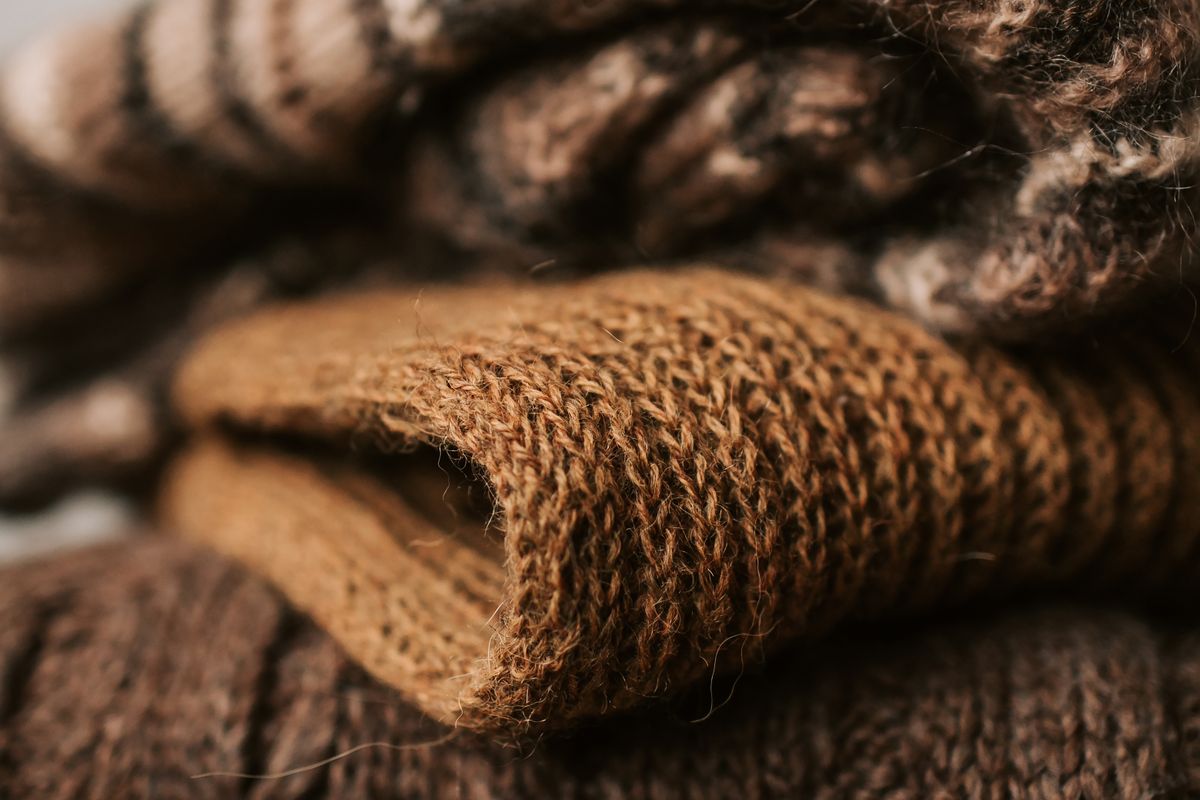
A pill is not a defect appearing on fabric. It’s fibre that was already there, working loose and tangling.
Every yarn is a bundle of individual fibres. The long ones form the core. The short ones sit at the edge, and under movement and friction they migrate out of the twist, catch on each other, and mat into the small ball you eventually pick at. Nothing is added to the sweater — components that were already inside it are rearranging.
Staple length is the starting variable
Short fibres have more loose ends per gram, so there’s more available to escape. Long-staple fibre makes smoother yarn simply because each strand is anchored along more of its length.
This is why processing matters as much as breed. Combed yarn has had the short material removed before spinning; carded yarn has not. A hand-spinning account published by New Scientist makes the same point from the other direction: woollen-spun yarn from carded fleece keeps its fibres randomly arranged and airy, which is exactly the structure that lets them surface.
Merino is fine and comparatively long-stapled for its fineness, which is part of why it behaves better than coarser generic wool — though merino’s durability limits come from the same fineness, and blends exist to compensate.
Twist, then density
Twist is the second lever, and the one most buyers never see. Higher twist clamps the fibres tighter together; low twist leaves them loose and lofty. This is the actual mechanism behind the familiar trade-off — the softest yarns feel soft because they’re minimally twisted, and minimally twisted yarns shed.
Knit density follows. A loose, open knit leaves the loops room to move against each other, generating friction internally. A dense knit holds everything in place. Brushed and brushed-back finishes — fleece, mohair, anything deliberately fuzzy — start with raised surface fibre by design, so they pill fastest of all.
Where it appears first tells you why
Underarms, cuffs, along the side seam, and wherever a bag strap crosses the shoulder or back. Those are friction points rather than weak spots, and pilling concentrated there points at how the garment is worn rather than at how it was made.
Pilling distributed evenly across the whole body, front and back, is the pattern that suggests the yarn rather than the wearer. With cotton-rich knits, pilling is often worse at points where a seam or a hard edge rubs — a desk, a car seat, a seatbelt.
Synthetic blends behave differently from natural ones. Polyester and nylon fibres are strong enough that once a pill forms it tends to stay attached and accumulate. Wool pills often detach and fall away on their own once they grow past a certain size, which is why a wool knit frequently looks better after a few wears than it did on day two.
What helps and what doesn’t
Use a fabric shaver or a sweater comb, and work on a flat surface. Pulling pills off by hand yanks fibre out of the yarn and leaves the surrounding area looser than it started, which invites the next round.
Washing sets the pace more than most people expect. Cold water, gentle cycle, turned inside out, and away from denim and anything with hardware — abrasive neighbours in the drum do more damage than the water does. Overloading a machine increases the rubbing, which is the mechanism pills depend on.
Turn Cuffs and collars are largely what they are. Before buying, pinch the yarn and look at how tightly it’s spun and how dense the knit is; loosest construction in the shop will be first in the drawer to fuzz.
FAQ
- Does pilling mean a sweater is badly made?
- Not usually. It means the yarn has loose surface fibre available to migrate, which is the same property that makes a knit feel soft. Very soft, lofty yarns tend to pill early and then stabilise once the loose fibre has shed. Persistent pilling across the whole surface after months is a stronger signal than a few bobbles under the arms.
- Does the pilling ever stop?
- It usually reduces. A new knit sheds its loose surface fibre in the first handful of wears, and once that excess is gone the rate drops sharply. Pilling that never settles points to a loosely twisted yarn or a very open knit rather than to a normal break-in period.
- Which knit structures resist pilling best?
- Tightly twisted yarns knitted at high density, made from combed long-staple fibre. Worsted-spun wool, where short fibres have been combed out and the remainder lie parallel, pills less than the woollen-spun equivalent. The trade-off is that both processes cost softness and loft, which is why the warmest-feeling knits are rarely the smoothest-wearing ones.
Written by
Maya Ellis
I started Dressing Time after one too many orders that came back in the wrong size. Everything here is built from published specifications, brand measurement charts and what owners actually report.
More in Everyday Wardrobe